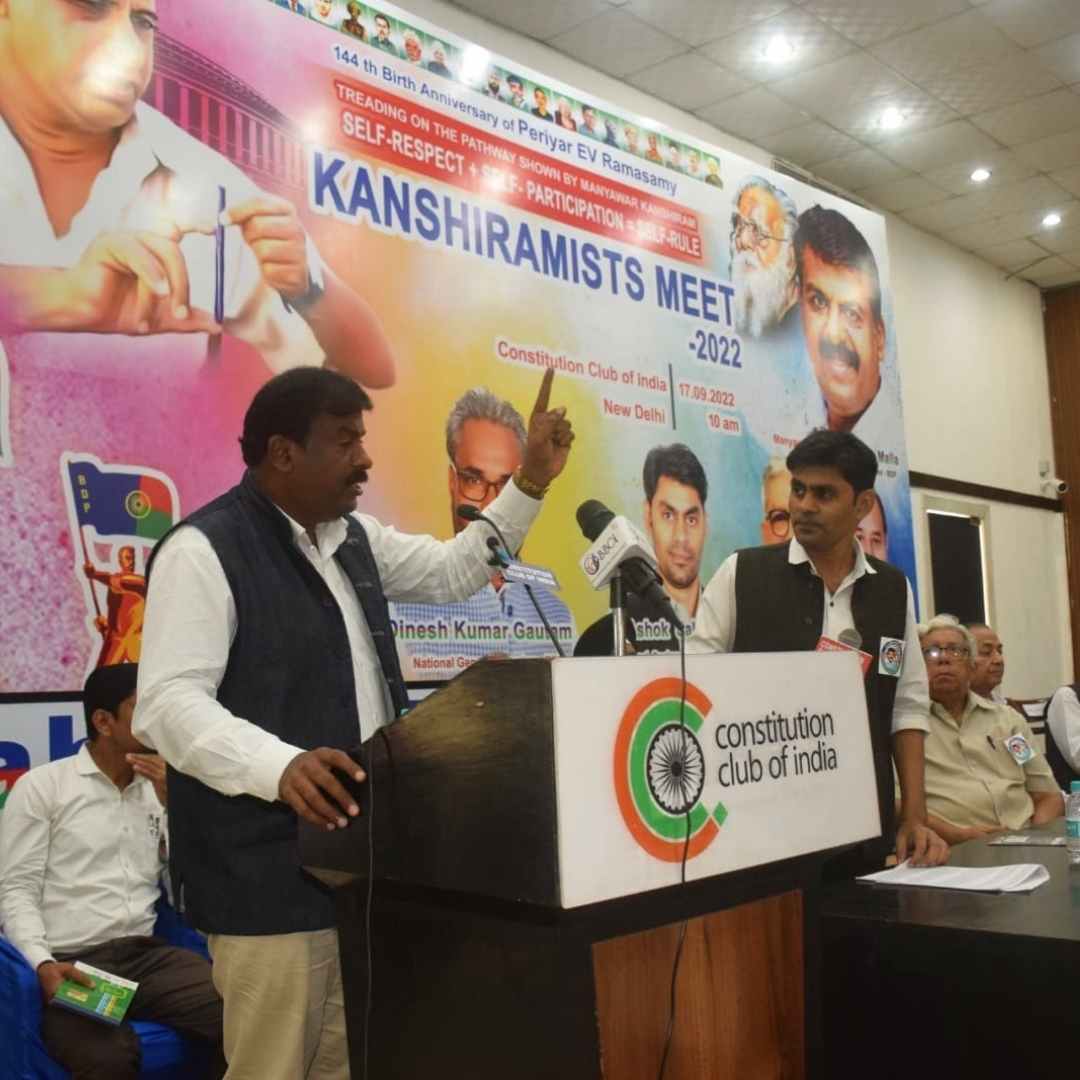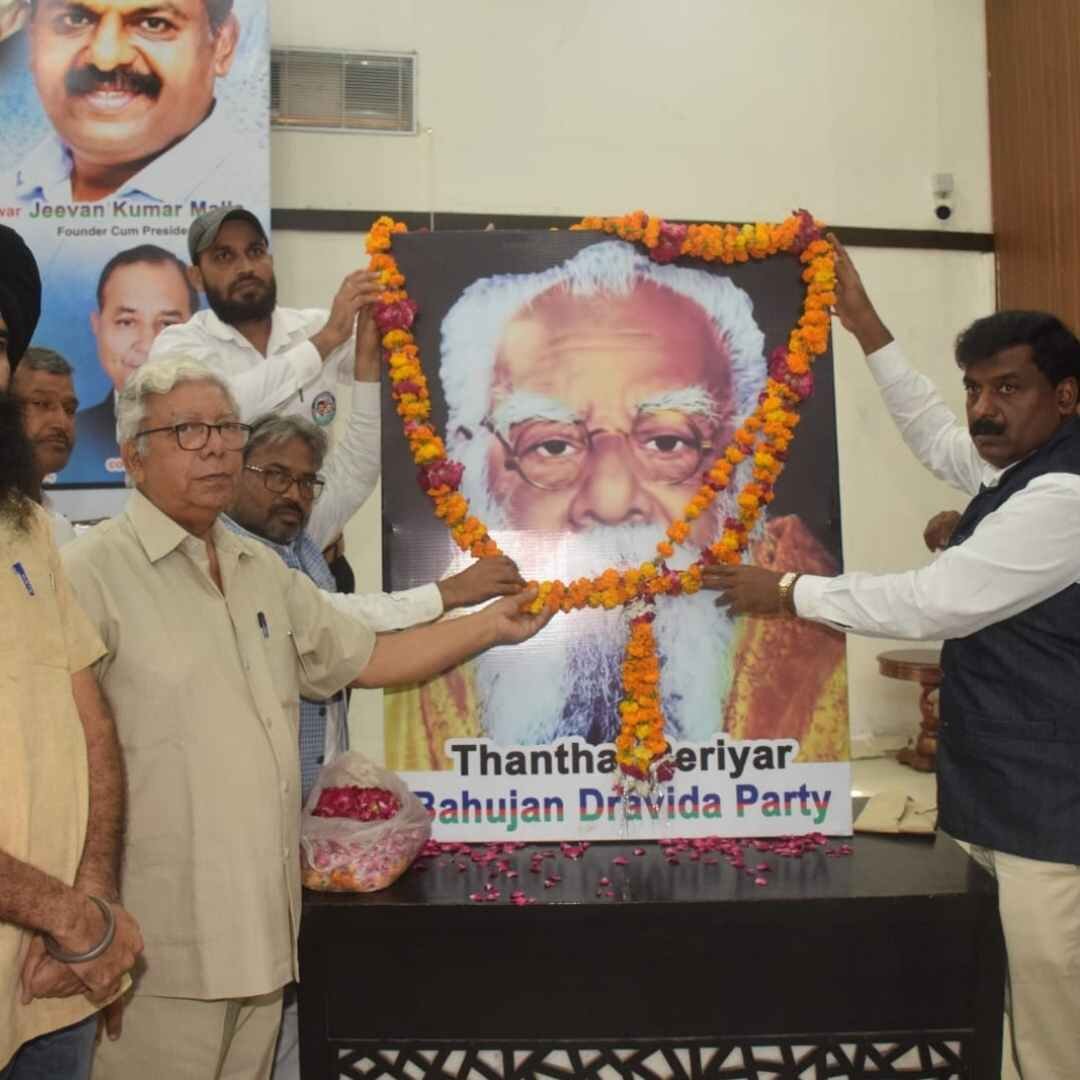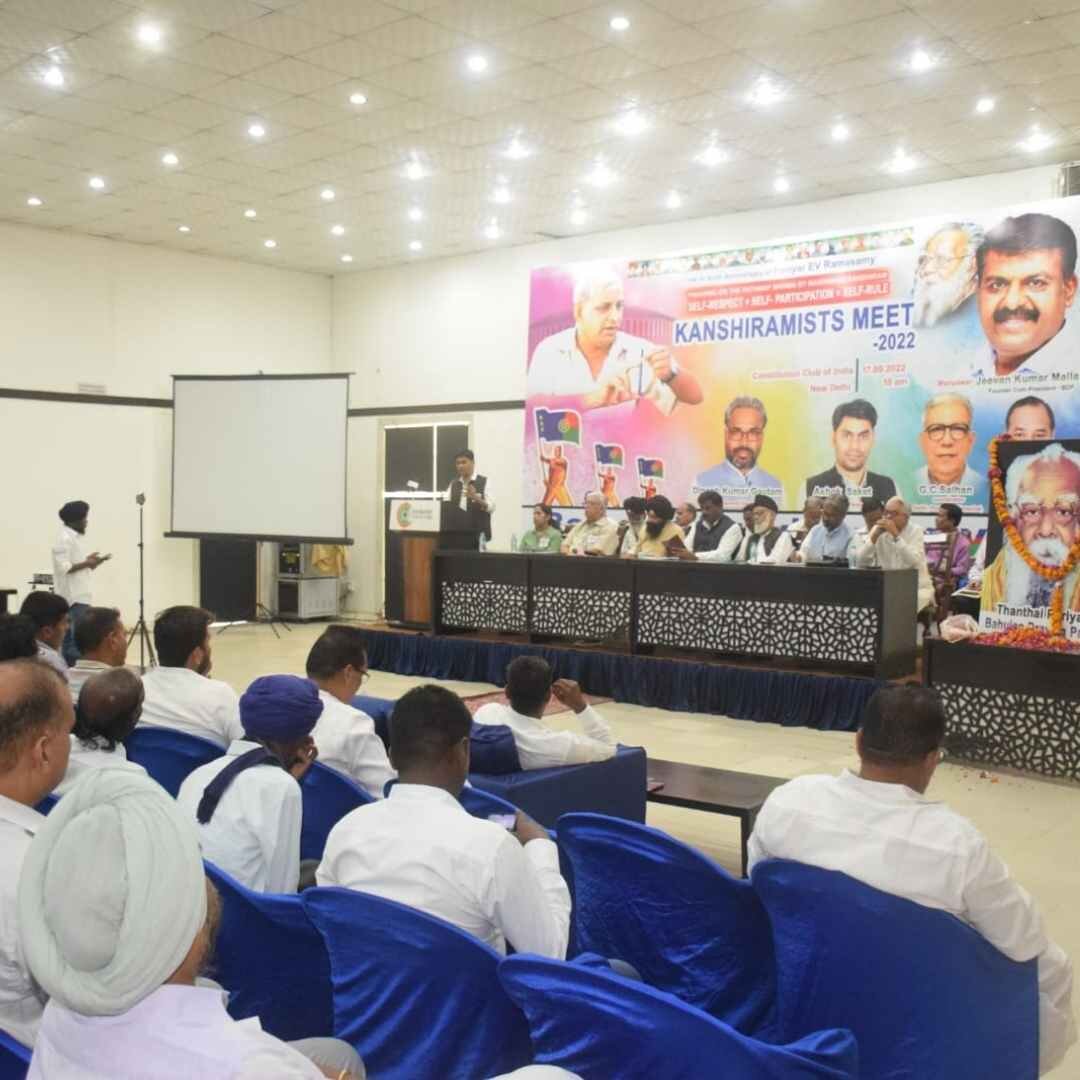




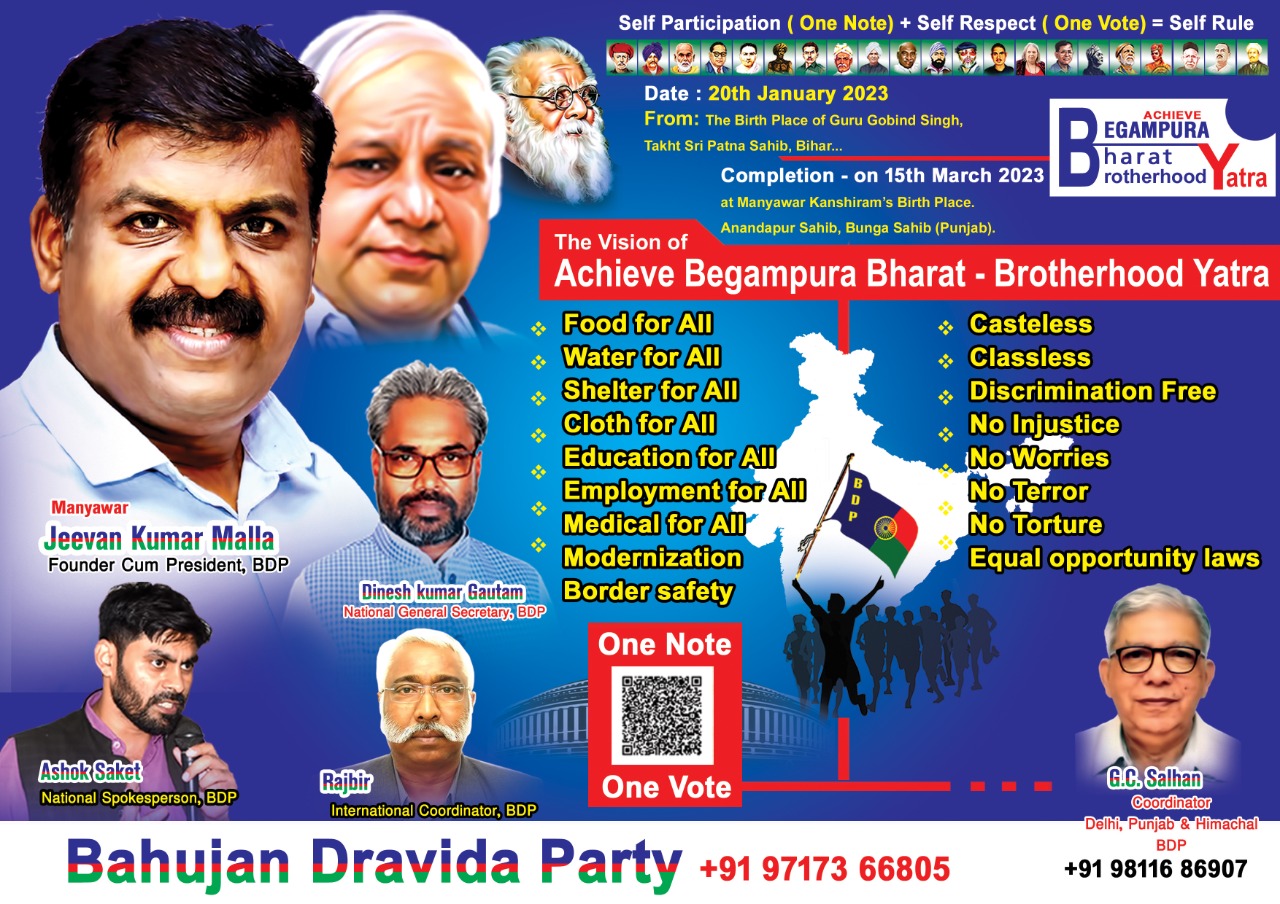
UPCOMING EVENTS
ABOUT THE FOUNDER
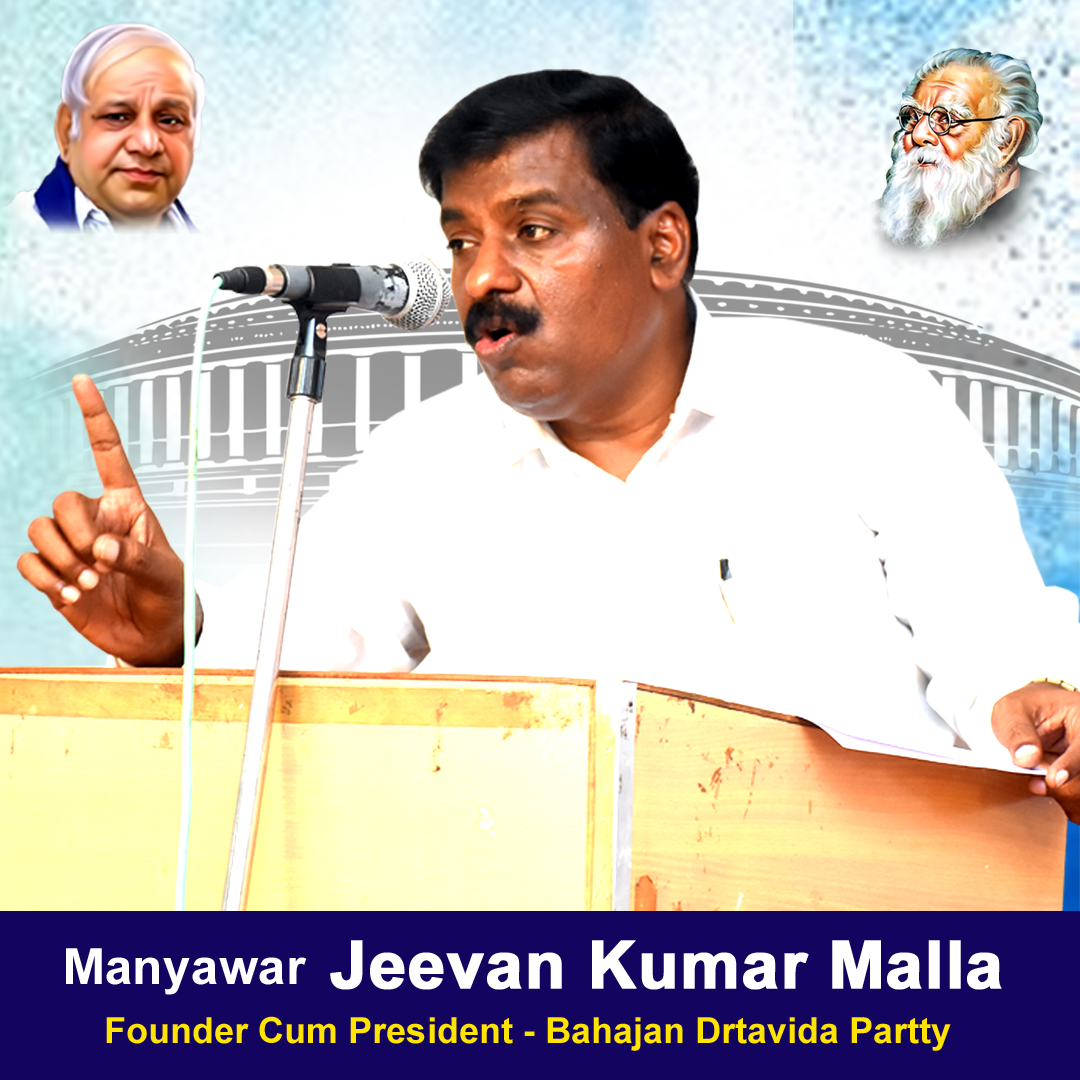
THE MAN OF VISION
Born in the year 1972 on November 27th to the Cooperative
Sub Registrar Mr.K.Elayaperumal of Kadodipannai, Tuticorin
District and Ms E.Pappuammal of Kothankulam, Thirunelveli
District, Mr Jeevankumar is an embodiment of determination,
inspiration, attitude and more…
Mr. Jeevan Kumar attended high school at St. Marys’ Boys
Hr.Sec School, Tuticorin, after which, he joined Pope’s Hr Sec
School, Sawyerpuram. Later he graduated from V.O.C College
and pursued law at Dr Ambedkar Law University, Chennai.
BAHUJAN DRAVIDA PARTY INSPIRATION
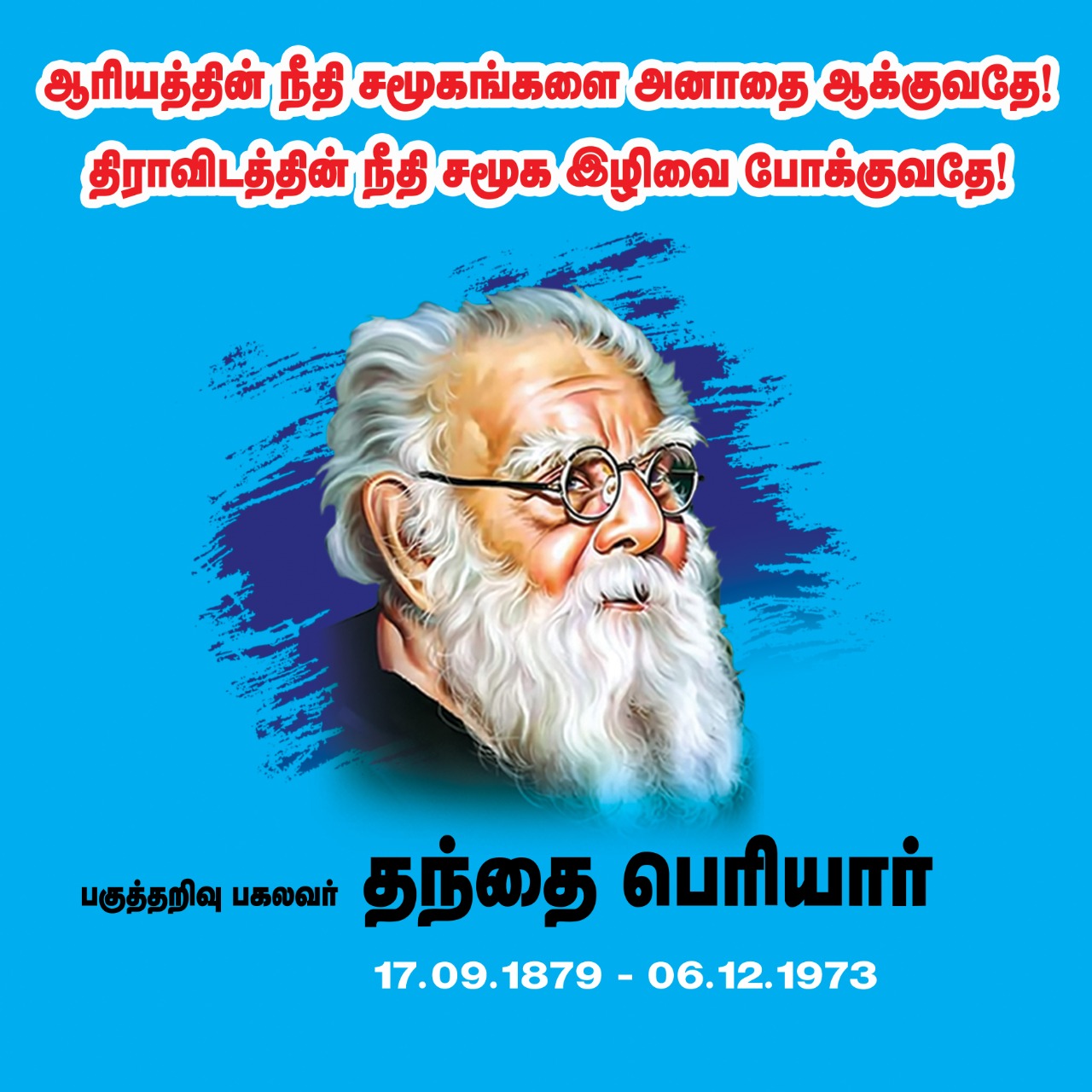
Periyar
Erode Venkata Ramasamy was born on 17th September 1879 at the Erode, which is part of the Coimbatore district in the yester years’ Madras Presidency.
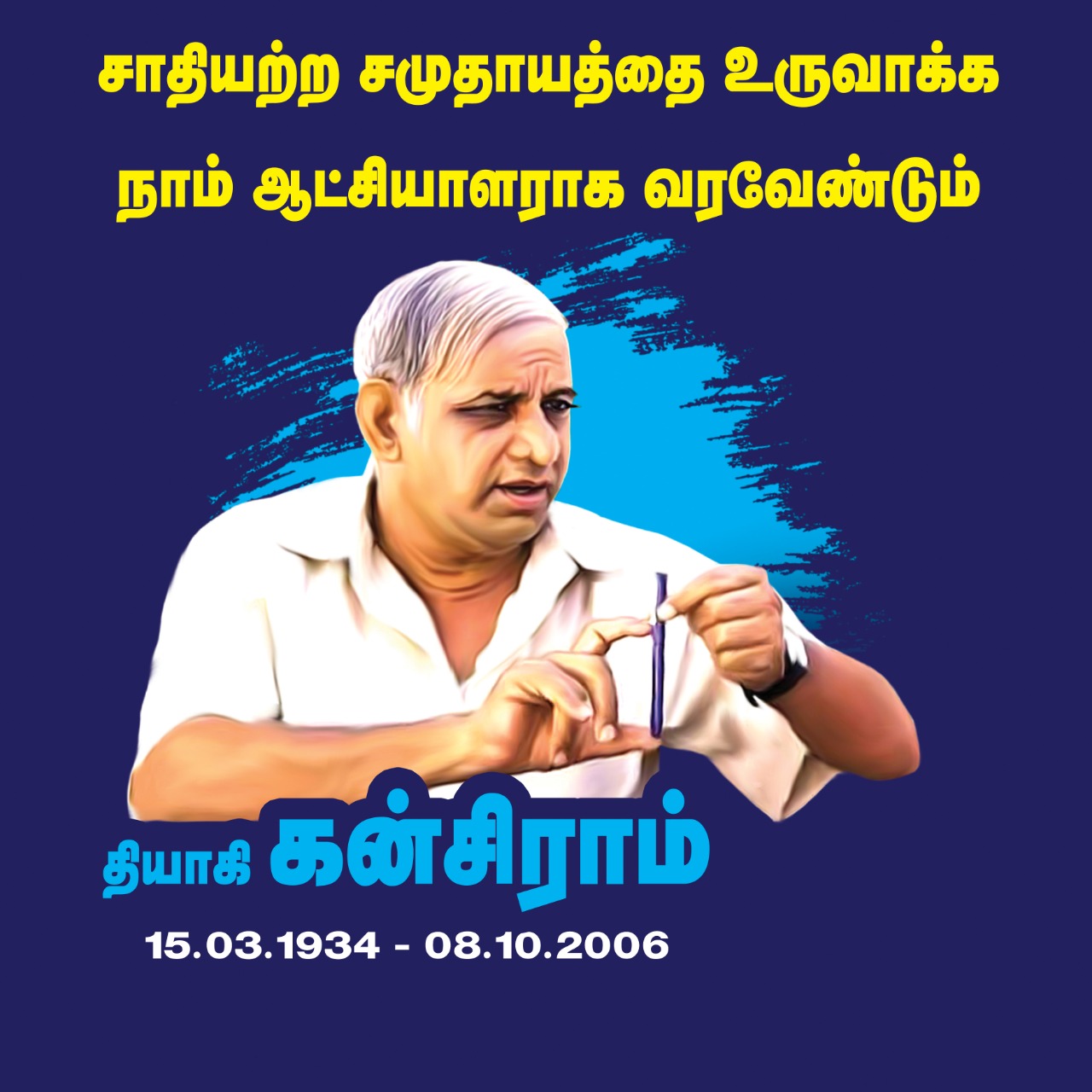
Manyawar Kanshiram
Manyavar Kanshi Ram was born on March 15, 1934, in Bungasahib village of Ropar District of Punjab (India). He was the eldest of eight siblings.
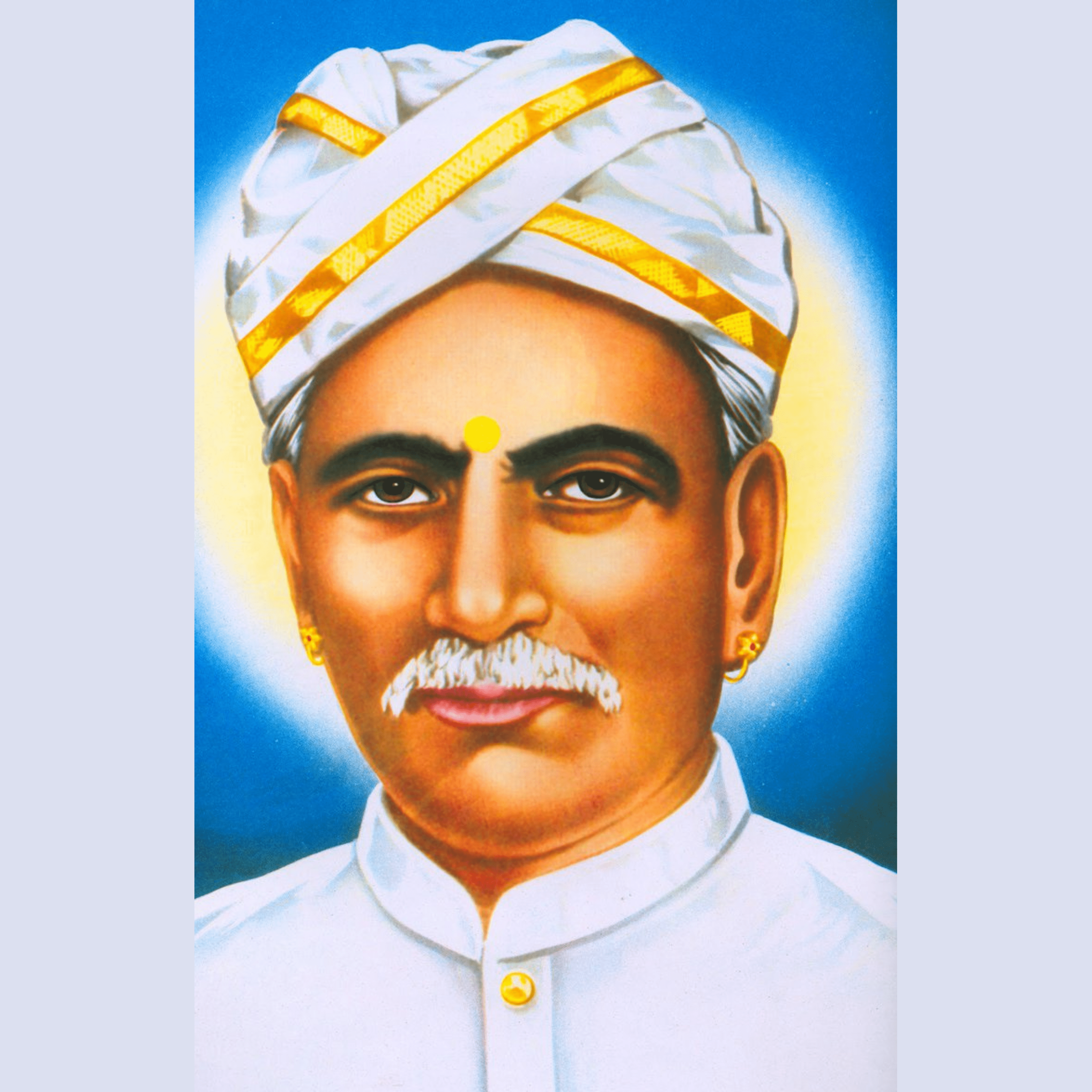
Mahatma Ayyangali
The spark of lightning would start to shine within them.During the golden period of Sanathana Dharma, the great Mahatma Ayyangali was born from the Sudhra class.
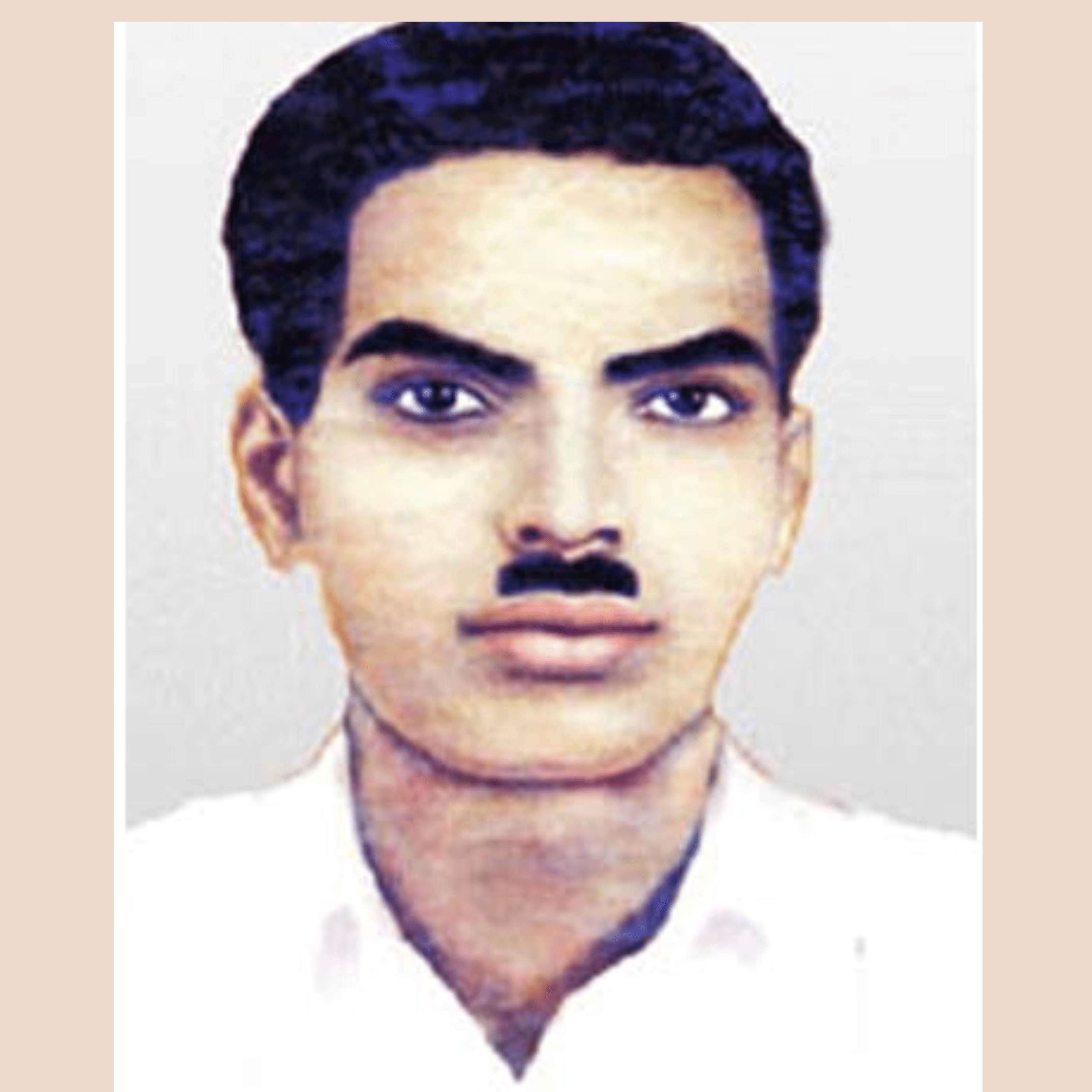
Maveeran Emmanuel Sekaran-
Maveeran Emmanuel Sekaran- A symbol of Thamilar(Dravidar) Liberation.In which almost 27 districts are occupied by the Mallar community.
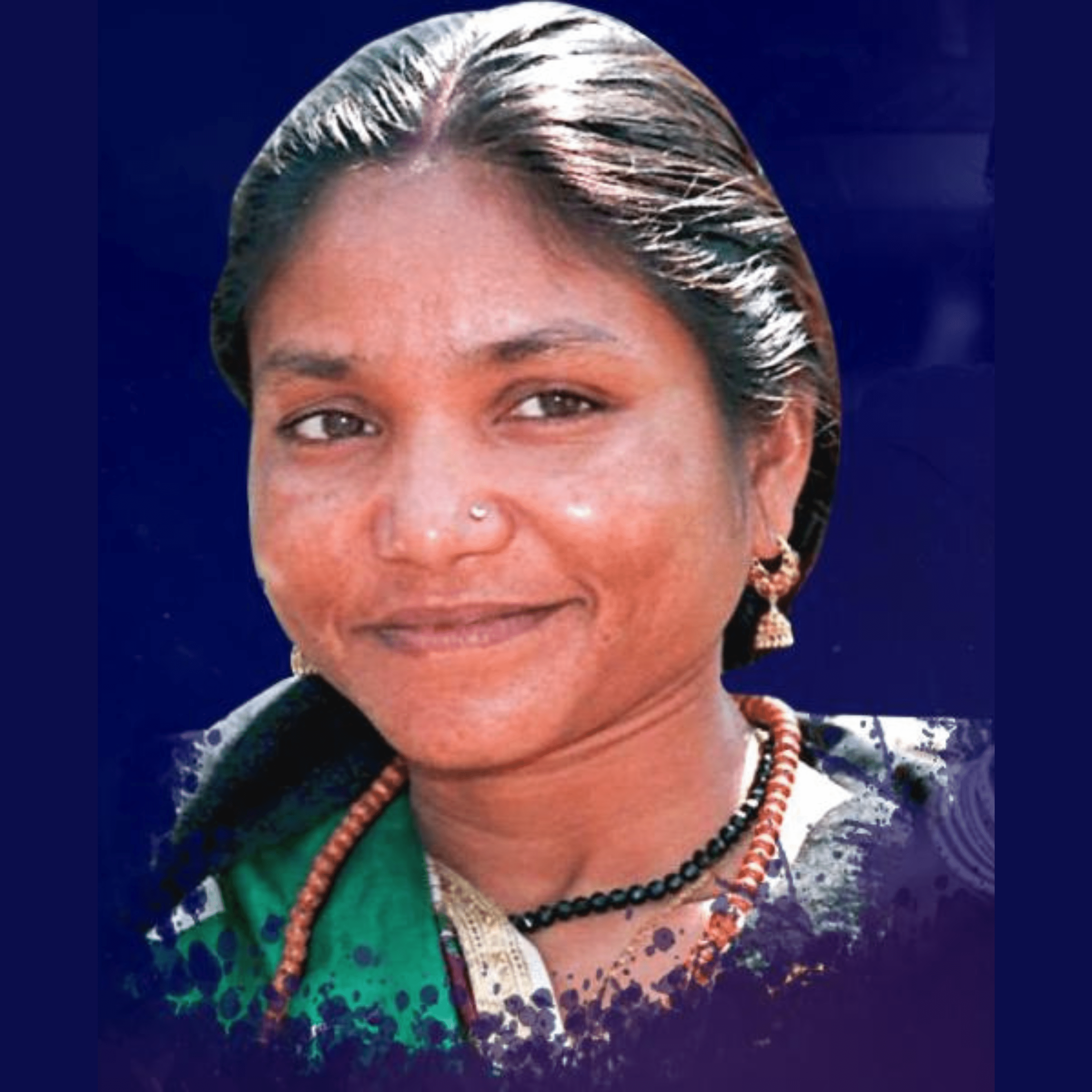
Phoolan Devi
”I was a simple girl from a low-caste family. But when society put me up against the wall, I reacted. I am also a Human Being” - Phoolan Devi..
I do not know if all of you know or do not know, but I want to tell one
important history which I have read from the books that the two most
brutal law enforced in India, one was Pesuva Brahmins in the Pune,
Maharashtra and the other Namboodiri Brahmins in the State of
Travancore in Kerala.
The command given by the Pesuva Brahmins to the Sudhras was to have
a mug around their neck, broom at their waist and bell on their hands.
Sudhras should carry this wherever they move. The same command was
given by the Namboothiri Brahmins to the Sudhras that women should
not hide their chest and another command that the Sudhra stood 64 feet
away from the Nair Community and 128 feet away from the Namboodiri
Brahmins. Sudras were called as an unseeable community or
unapproachable castes
During this dark age of Sudhra at Kerala, Mahatma Ayyankali was born
on 28th August 1863 in an agricultural family in Perumkattuvila,
Thiruvananthapuram. He belongs to the Pulia Caste.
When I read the history of Mahatma Ayyankali, I felt it was similar to
that of the history of Mahatma Phule's life.
Mahatma Phule faced caste discrimination when he went to attend the
marriage ceremony of his upper caste friend’s home, just like the same,
Ayyankaali also faced the caste discrimination in his childhood days
while playing football with his caste Hindu children. He was being beaten
up by upper caste Hindus. On that same day, he vowed not to play with
upper caste Hindus.
Even before Baba sahib Ambedkar, Mahatma Ayyankali used the formula
"Educate, Agitate & Organise". His struggle was to create a casteless
society. Mahatma Ayyankali's life struggle was to achieve "Equality,
Liberty and brotherhood" in Indian Society. Your education should be
aimed at social transformation and economic emancipation. If your
education remains as an education that fills your stomach, it will destroy
not only you, it will destroy your own community too.
if you get the right education, there will be a rebellious provoke within
you, that rebellion will automatically consolidate you as a sanga.
At the Age of 30, Mahatma Ayyankali started his awareness programme
to the Bahujan Dravida Masses through his "bow cart" Rally. He rode a
"Bow Cart" against the ban on untouchables from accessing public roads
by caste Hindus.
To crush the chain of slavery built in the name of the castes, Mahatma
Ayyankali wrapped a robe around his shoulder, tied a turban and travel
with his bow cart on the public streets and markets. Although this event
refreshed the oppressed people, it annoyed and surprised the upper caste
hindus
Ayyangali held a rally in Balaramapuram demanding the rights of the
‘untouchables. The rally was called the "Walk for Freedom." The rally
was infiltrated by upper caste Hindu Gundas. Thus, the great riot broke
out. The riot was known as the ‘‘Chaliyar riots’’. Hundreds of Bahujan
Dravidians were injured in this riot, But they fought very bravely under
the leadership of Mahatma Ayyankali and won fundamental rights.
As the Scheduled Caste students were not allowed to enter schools,
Mahatma Ayyankali encouraged Pulaya farmers to go on strike and
declared, “If our kids are not allowed to enter your schools, your
paddies will grow mere weeds.” This was the first strike of the working
class in Kerala conducted by Mahatma Ayyankali. After the long struggle
of Mahatama Ayyankali with the working-class people, On March 1 1910
the Travancore government ordered that Pulaya children to be admitted in
all schools which Ezhava children have access to.
Inspired by Sree Narayana Guru, a social reformer from Ezhava caste,
Ayyankali started "Sadhu Jana Paripalana Sangham” which later raised
funds to start their own schools. In 1916 he established Theeyankara
Pulaya School. Later, Hundreds of offices of "Sadhu Jana Paripaalana
Sangham (SJPS) were turned into schools.
He removed the sub caste contradictions that existed among the
scheduled caste in Kerala and united them to travel under one umbrella.
Moreover, he was a pioneer in empowering the Bahujan Dravida in
Educationally, socially and he also fought to politicize the Bahujan
Dravida Masses
In 1912, Ayyankali was nominated as a member of the Sri Mulam
Popular Assembly – a position he held till his death. Mahatma Ayyankali
was the first Scheduled Caste person to be nominated to the legislature in
colonial India. In the Assembly, Ayyankali consistently raised the
problems being encountered by Pulayar children in acquiring education,
poor representation of Bahujan Dravidas in jobs, unemployment and land
for Bahujan Dravidas. That forced the government to sit up and take
notice and in 1914, an order was issued, stipulating strict adherence to the
educational policy.
Ayyangali passed away on 18 June 1941, but his immense struggle of
history did not reach at the national level. If Mahatma Ayyankali had not
been struggled for the social change, the situation of the Bahujan Dravida
in Kerala would have been much worse.
Some social group leaders, who worked on the basis of Ayyankali have
become stooges of the Brahminical forces and also uphold the policy
which was against Ayyankali's policies.
But the true followers of Ayyankali have been continuously fighting for
the highest goal of equality, liberty fraternity.
Jai Kanshiram Jai Mahatma Ayyan Kali
Tamil Nadu consists of 32 districts, in which almost 27 districts are occupied by the
Mallar community, who once ruled Tamil Nadu, as noted in history as the Chera, Chola and
Pandiya kingdom. Later with the Aryan invasion, the community gradually lost their power
and were reduced to the status of slaves.
As on date, the overall population of the Mallar community in Tamil Nadu is an
estimated 1,75,00,000. The Mallar community is known for its fight against the evil
discrimination in the Hindu social system. Also, in its effort to uphold their self-respect and
dignity and in a show of expressing their discontentment, they opted for getting converted
into Muslims and Christians in the past. The Mallar community unperturbed by oppression
unleashed against them had led several agitations to preserve the self-respect of the people of
Scheduled Caste (SC) in Tamil Nadu. The community holds the privilege for not bowing down
before the Manuvadis’ for the sake of their social development. However, known for their
innocence and contained emotional attitude, they failed to understand the might of their
numerical strength and its significance in attaining political power. Therefore, the Mallar
community lagged behind others in the realms of social, economical and educational progress.
Though, agriculture was the main occupation, more than 80% of people were landless
agricultural coolie while the remaining are small scale and marginal farmers.
In such a scenario, the revolutionary social reformer in the Malla community, Thiyagi
Immanuel Sekaran born in 1924. After witnessing the oppression and exploitation of
Bahujan brother’s and their meager existence, he felt a lot to be desired for the
betterment of the community. In 1942, Dr. Ambedkar appealed to the Scheduled Caste
community through Radio, to join the British Army. After hearing the appeal, young
Shekaran did not hesitate for a moment and joined the military service at once. Later,
on visiting his district on availing leave and seeing the miserable condition of the
Bahujans, and the caste atrocities unleashed against them by the upper caste people
and the ruthless exploitation of the innocent Bahujans, he decided not to return to the
Military and to work for the betterment of the suffering masses. Thereby he decided to
work for the self respect and justice for the Scheduled Caste and other Backward
Classes, who were also subjected to untouchability.
Accordingly, in 1946 in unison with Thekkampatti Balasundaram, he conducted a
very big convention for the Mallar Community at Madurai. In Tamil Nadu, Mallar is the
first community to recognize and accept the scholarship of Dr. Ambedkar and his works.
Similarly, Dr. Ambedkar also expressed his delight for the unity of Mallar community in
Tamil Nadu.
Immanuel Sekharan, for a long time could not find an appropriate measure for
alleviating the miseries of discrimination meted out to the Mallar community. However, , he
unified the Mallars and other socially and economically backward castes through the
Organization of Depressed Classes in 1952 and expressed their opposition to upper caste
people.
During 1953, Shri. Rajagopalachari (Brahmin) was forced to resign his post as the Chief
Minister of Tamil Nadu, who was succeeded by Shri. Kamaraj Nadar and Shri. Kakkan who
hailed from Scheduled Caste became the Home Minister in Nadar Cabinet. Due to the
enormous political stature of Shri. Kakkan, Shri. Immanuel Sekaran joined the Congress Party
and was subsequently appointed as the spokesperson for Ramnad District Congress.
However, as he was leading the civil rights movement and the waging the battle against
hegemony of Brahiminical Caste System, he became incredibly popular among all the
Backward Caste of Shudhras but for Kallar Community. Because of his active rebellion against
Brahmanism, it was only natural that Congress Party distanced itself from him and his
activities. Consequently in 1955, he left the Congress and fielded two Backward Class
Candidates with the support of Forward Block against the Congress in the local body elections
and managed to win both the seats.
In 1956, to create the socio-political awareness among the Mallar Community, he
organized the First Political Conference of Mallars on 6 th December 1956. On the 6 th
December, the Greatest Liberation Icon of India Dr. Babasaheb Ambedkar, passed away. On
hearing the demise of Dr. Babasaheb Ambedkar, he passed the condolence resolution to
mourn the death of Dr. Babasaheb Ambedkar in the very same conference. The Mallar
community is the first community in the world to pass the condolence resolution to mourn the
death of Dr. Babasaheb Ambedkar. During this convention, Shri. Emmanuel Sekaran conveyed
Dr. Babasaheb Ambedkar’s message to Mallars that Political Power is the only solution to
surmount the sufferings and atrocities. The entire speech delivered by Shri. Emmanuel
Sekaran on the occasion was about the importance of gaining Political Power. He
emphasized on the political power held by Brahminical forces and its implications viz., the
suffering of the people of Mallar and other socially oppressed classes. Therefore, he
underscored the significance of the Political Power to live with self-respect. He enlightened
the Mallars, to progress towards capturing of Political power in the Centre as well as in the
State, which he felt was the only solution to lead a dignified life filled with self-respect and
equal justice.
Thereafter he started organizing the Mallars and other Backward Class people in Tamil
Nadu towards attaining self-respect. But before he could make much headway, he was
murdered on 11 th September, 1957 by the agents of caste culture. During the Ramnad riots, a
worst of its kind, a series of politically motivated violent clashes took place between July and
September, 1957, just a month before the 1957 election to the Lok Sabha. In the election,
Thevar community as a whole supported the forward block led by Muthuramalingam Thevar
and the because of this, the Mallar and other Backward Communities supported the Congress
party. Ironically, the SC/ST/OBC communities failed to read the conspiracy game hatched by
the Congress, and paid a heavy price on September 11, 1957, as the 33-year-old
Emmanuelsekaran, the leader of Scheduled Caste Congress delegation was murdered at the
peace conference in Paramkudi.
When, Shaheed Emmanuel Sekaran served in the Army with Sant Bantaram Ghera,
Founder, All India Adi Dharam Mission Panjab. They two were close friends. Because of the
caste discrimination in the military, the two decided to resign from the military and work for
the socially oppressed community. Shaheed Emmanuel Sekaran decided to work for social
liberation in Tamil Nadu. Sant Bantaram Ghera decided to do their socio-cultural work at
Punjab. They did their work until the end of life as they decided.
On the anniversary of Shaheed Immanuel's birthday, Every Year under the leadership of
Sant Satwinder Singh Heera, the national president of the All India Adi dharam Mission of
Punjab have been celebrating the occasion with great gratitude.
Similarly, over 1000 persons from the Punjab, every year come to the memorial place of
Saheed Immanuel Sekaran at Paramakudi, Tamilnadu to pay their tribute of his great soul.
Though he is no more, Maveeran Emmanuelsekaran is revered as a Liberation icon and
a source of political empowerment by all the Scheduled Caste people and Socially Backward
Classes, and remembered as a the one who fought against the atrocities unleashed by caste
culture and treated at a par with Dr. Babasaheb Ambedkar. Therefore, on 11 September every
year, as a mark of gratitude and respect, lakhs of people from all over Tamil Nadu mostly from
among the Mallars visit his Memorial at Paramkudi in Ramnadu district, to derive inspiration
to carry forward the legacy of Maveeran Emmanuelsekaran in their arduous struggle live a
dignified life with SELF RESPECT.
Jeevan Kumar Malla
National President, Bahujan Dravida Party
New Delhi
9442608416
In a male dominated (i.e. brahminical patriarchal society), Scheduled Caste women suffered
unimaginable oppressions, not only through caste but gender too. Our great ancestors of the Bahujan
Movement have given voices to liberate the women from these atrocities and humiliation. But the laws
in the Manusmriti and other brahminical scriptures close all the economic, social, political and other
channels through which Scheduled Castes women could be uplifted. After the Independence of India,
Dr.Baba Saheb Ambedkar wrote many books and articles for the liberal rights of the women. He wanted
to liberate the Indian women from this system through Hindu Code Bill. But Nehru and his Congress
vehemently opposed this Bill. That was the reason why Baba Saheb Ambedkar resigned from the
Cabinet.
In the History of India, there were many Scheduled Castes women leaders who fought for the
liberation of the oppressed women. One among such women leader is the “Real Iron Lady Phoolan
Devi”. We painfully remember the Militant Symbol of Women Rights, Ms Phoolan Devi’s Fiftieth (50 th )
Birth Anniversary on August 10 th 2013. Every Bahujan woman must learn the meaning of courage from
her. She was born on August 10 th 1963 to a poor lower caste Mallah family in Uttar Pradesh. She was a
victim of caste oppression, discrimination, humiliation and gender exploitation. When she was about 15
years, Ms.Phoolan Devi was gang raped in her home by the ‘upper caste’ village leader in front of her
parents watching, and soon after the incident, police at Kalpi (U.P.) Jail did the same thing to humiliate
her. After, she has tolerated extreme caste and gender oppression and sexual abuse under the
domination of brahminical landowners and the state. She formed an army of Mallahs against
brahminical Caste System. She became the subject of great fame throughout India.
In the year 1981, Ms Phoolan Devi came to the International attention. As a leader of a gang,
who allegedly killed 22 ‘upper caste’ men in a village of UP (better known as Behmai massacre). This was
the “greatest example of Dalit upsurge in Modern Indian History”. After this massacre, Police launched
a huge manhunt using helicopters and thousands of men to catch her. But because of the lakhs of poor
Bahujan Peoples’ support, the police was not able to capture her. Finally, the police and government
decided to negotiate and a deal was made with her that she and her gang members would not face the
death penalty. As a part of arrangement, Ms. Phoolan Devi surrendered in 1983 and served 11 years in
jail without trial in prison. Ms Phoolan Devi was released in 1994, she became a Politician and converted
to Buddhism. After she came out from the prison, in 1995, she launched “Eklavya Sena” a group that
was aimed at teaching Bahujan’s men and women “the art of Self-Defence”.
Ms Phoolan Devi wanted to fight for women rights by legal means, she said “I am Serious, I have
not been able to do anything in the Parliament for women because I am always running off to the courts
to face my reopened cases by these ‘upper caste’ people. These ‘upper caste’ people are unable to
tolerate me to see as a Member of Parliament. What kind of justice is this? They are after me because I
am a Dalit, that too, a woman. I made a mistake when I surrendered to the Government. I took revenge
against torture and injustice not against men but against anti-social and anti women goondas. Then she
explained- “But I am still enraged when women come to me and say they have been raped and the
police will not do anything against these men.
In 1998, Ms Phoolan Devi attended and addressed the First World Dalit Convention held in Kuala
Lumpur (Malaysia). During that time, a western journalist asked about being raped. She replied that
“you can call it rape in your fancy language. Do you have any idea what it’s like to live in a village in
India? What you call rape? That kind of thing happens to Scheduled Caste women in the Indian Village
every day. It is assumed that the daughter of Scheduled Castes are for the use of the ‘upper castes’. They
are assuming that we are their property. In the Scheduled Caste villages there are no toilets, so we must
go to the fields, and the moment we arrive, these ‘upper caste’ man lay us there. We are considered the
property of these ‘upper caste’. They would not let us live in peace. You will never understand what kind
of humiliation that is. If they wanted to rape us, to molest us and our family objected, they rape us in
front of our families.” That time, the international press gave a lot importance to her statement. Some
of the Members of British Parliament even nominated her name for Nobel Peace Prize.
Even though she was an illiterate, she lived with the principle and the philosophy of
Ambedkarism. She honestly fought for the liberation of the Bahujan Community, especially women. She
started the path of revolution at the age of 15 years. 11 years she was in Jail, remaining 6 to 8 years
only she worked for the oppressed and exploited. The evil brahminical forces were unable to stand
before her sincerity, courage and commitment to Bahujan cause. They planned and got here murdered
on July 25 th 2001 in Delhi.
The brahmincal forces are trying to systematically destroy every Bahujan icons in India.
Unfortunately, our so called elite persons of SC/ST/OBCs fail to read the mindset of Manuvad and try to
justify the game of brahmins fooling our poor people. That’s why, our Bahujan people have been
continuously facing discrimination and humiliation all over the country. In the last 100 years, great
leaders have come and passed away, but our slavery remains.
The life and struggles of “IRON LADY” Phoolan Devi would continue to inspire coming
generations of Bahujan Samaj to keep the flag of revolt against brahminical caste system till the
oppressed and exploited regain their lost rights and self-respect. This would be the most befitting
tribute to this symbol of women’s liberation in modern India.
Even as a child, the family found in him, a rebellious spirit. At
School he questioned the authorities when he saw prejudiced
treatment meted out to his fellow students especially from the
marganilaised sections. This rebellious spirit, that lay like a
hearth inside him, blazed into furious flames during his college
days and lead him to think out of some way that could better
the lot of the broke, muted and maimed subaltern groups.
The heart that was throbbing out of agony, looking at the
tentacles of miseries that were swallowing his people, let its
blood in donation more than 30 times.
The leader inside him
quickly made him realise the power of many hands and he
campaigned an awareness among college students in and
around Tuticorin District, Tamilnadu.
As he matured into manhood, his perception of the society and
the marginalised segment took a multi-dimensional turn. The
intensive reading on various leaders who worked for the
betterment of the society and his own observations of the
society through practically living with and amongst the
marginalised segments made him think. He knew he had
greater responsibilities to shoulder.
It was about this time that he got the opportunity to meet
Mr.Henry Tephen, the then Director of the popular Human
Rights organisation - People’s Watch. This meeting had a
remarkable influence on him and he began working as an
Activist who went around the nooks and corners of South
Tamilnadu, championing the cause of Human Rights, particulary
for the marginalised.
As a Human Rights Activist, he conducted many agitation
against the violation of Human Rights. He took part in many
Campaigns which also include:
Campaign Against Torture
Campaign on Save River Tamiraparani
Campaign against Alchoholism
Anti Coca Cola Campaign
Campaign on right to vote
Amidst his multifarious activities that incarnated as showers of
rain to the parched throats of the people at the grassroot level,
he organised a long continious Fasting to redeem the Separate
Panchayat of Eruvapapuram. This intense struggle went on for
502 days.
Mr Jeevan Kumar led several protests for the land rights of
Dalits, Adivasis and Religious Minorities and discrimination,
humiliation and atrocities against Dalits and women. Through
agitations he has fulfilled few of their demands too. At the
same time the government was unable to tolerate his activism
so , they registered more than 10 cases against Mr Jeevan. Now
he has been acquitted from all the cases.
It was during these days that he learnt the power of Politics. It
dawned on him that:-
1. Power alone can destroy the power
2. Political power is the master key to open any lock.
He has rooted on the principles of Periyar's social justice and
rationality. Later he was inspired by Manyawar Kanshiram’s
Social Transformation and Economical Emancipation ideology.
we all know that Manywar Kanshiram ji was brought up from
the school of Anandpur Sahib, Punjab. He was the only political
leader in India, who openly declared in the Indian parliament
that Guru Grant sahib is our party manifesto.
In 2001, Mr Jeevan Kumar went along with some dalit activists
to meet Manyawar Kanshiram, but his fellow tamil assitant
denied to meet Manyawar Kanshiram. Mr Jeevan Kumar’s mind
filed with the thought of Kanshiram’s ideology. Eventhough he
started his social political work among the SC/ST/OBC and
Religious Minorities.
In 2009, on behalf of Bahujan Samaj Party, Mr Jeevan Kumar
contested parliementry election at Tuticorin parliementry
Constituency, Tamilnadu. In 2014, to Save the Kanshiram’s
Bahujan Movement, he contested the Parliementry election in
the year 2014 at Bothogi constituency, Uttrapradesh. In 2019,
He contested against Mr Modi at Varnasi, due to Manuvad’s
Conspiracy, his nomination file was rejected. But Mr Jeevan
Kumar immediately filed the case against the election
commission for the cancellation of his nomination.
As a dutiful representative of the sons of this soil, he,
conducted Kanshiram Sandesh yathra to create awareness of
Kanshiram and his messages. It was a 3500 kilometre cycle
yathra. He stayed in villages and ate the food provided by the
village people. HIs next yathra was Prabutha Bharath yathra.
This yathra he started from Erode the birth place of Periyar to
dessiminate the message of Thanthai Periyar.
Time unfolded to him to sit with other OBC party leaders for
political amalgamation of all the communities except Brahmins.
A leader is distinguished from a boss by his attitude. While a
boss says- “Work!”, a leader would say -“Let’s work”. In this
respect, any person who has met Mr. Jeevan Kumar in person
would vouch that he is a “Let’s work!” man, to the core.
This hard-working man has been a resource tank of
information, innovation and inspiration to many, particularly
youngsters. He believes in promoting the cadres and leaders
too. Brimming with a never-say-die spirit, this down-to-the-
earth youth seems to be aligning a billion subaltern’s voice
when he confidently says:
“Very soon, majority (Ruling Class) will sit in both - the
Parliement and the Legislative Assembly to demolish the
existing Caste Sysem”.
In 2019, Mr Jeevan Kumar started the political party named
BAHUJAN DRAVIDA PARTY along with his fellow followers. At
present the party is getting rooted throughout the nation with
staunch support of Kanshiramists.
After Manyawar demise, Mr Jeevan Kumar is the only person in
India carrying his caravan where Manyawar left. He has been
intensively doing campaign for the political emancipation of the
non-brahmins in India to create an egalitarian society.
HIS VISION CONTINUES…
He later became known as "Periyar" which means "one respected “in Tamil.. E.V.
Ramasamy's father arranged for a wedding when he was nineteen years old. His bride,
Nagammai, was only age of 13. His first wife, Nagammai, died in 1933. E.V.
Ramasamy was married for the second time in July 1948. His second wife is
Maniammai,Periyar had attended school for five years.
At a young age, he began to question the contradictions in the stories of Hindu
mythology. As Periyar grew, he felt that people use religion as a mask to deceive
innocent people and therefore he decided that one task he would definitely do in life
would be to warn people against superstition and Brahmin priests.
Periyar started his political career as a Congress worker in his hometown Erode. He
quarreled with Gandhi over the question of separate dining for Brahmin and non-
Brahmin students at Gurukkulam, a Congress-sponsored school owned by nationalist
leader V S Iyer in Cheranmahadevi near Tirunelveli.
Gandhi proposed a compromise, arguing that while it may not be a sin for a person not
to dine with another, he would rather respect their principles.
During this time Justice Party was also emerged. In 1917, in a manifesto released by
Justice Party, it has been mentioned that out of 171 persons who had been selected for
Madras provincial civil service, 100 were brahmins.
In the same way, out of 273 persons who had been selected for Madras members of
subordinate service, 165 were brahmins. In jail department, the persons selected were
277 out of which 190 were brahmins.
In the education department, the total persons selected were 515, out of which 365
were Brahmins.
In 1920, 16 persons had been selected in a competitive examination for civil service
out of which 15 were brahmins.
Five High Court judges were appointed and all of them were brahmins.
Out of the 128 district munsifs appointed, 93 were brahmins.
The congress failed to addressed these issues in their party. So Periyar resigned from
the party in 1925, and associated himself with the Justice Party and the Self Respect
Movement, which opposed the dominance of Brahmins in social life, especially the
bureaucracy.
The Justice Party had a decade earlier advocated reservation for non-Brahmins in the
bureaucracy and, after coming to power in the Madras Presidency, issued an order to
implement it.
Periyar’s Struggle…
During this time, Periyar’s fame spread beyond the Tamil region during the
Vaikom Satyagraha, a mass movement to demand that lower caste persons be
given the right to use a public path in front of the famous Vaikom temple.
Periyar took part in the agitation with his wife, and was arrested twice. He
would later be referred to as VaikomVeerar (Hero of Vaikom). Vaikom is not a
part of Tamilnadu. It is a part of Kerela.
Periyar protests against Brahminism/Hinduism by breaking the Brahminical
idol of Ganesha – “Elephant Headed god” on Buddha Purnima, 1953
Women played an unprecedented role in the Vaikom Satyagraha, with the
large-scale participation of women being witnessed for the first time during the
Satyagraha, marking the passage of women into the socio-political
consciousness of the country.
Periyar advised the women of Tamil Nadu to cut their long hair, make it Bob
Cut and women should stop wearing Sarees i.e., Dress up like a man (unisex
dress code) and consistently argued for the equal rights of women in marriage,
the inheritance of property and civic life in general.
He fought for women's rights and self-respect in marriage. He said the concept
of marriage was introduced in ancient times to make a woman slave to a man.
If marriage had to take place, he called for it to be simple, ideally a registered
wedding.
In 1926 when the resolution was passed that all the Untouchables should
convert to Islam. The people became frightened so Periyar asked them since
they were hesitant to convert to Islam at least they should call themselves Non-
Hindu
When someone asked Dr. Ambedkar why you don't come to Tamilnadu that
much...? Ambedkar replied saying, "Periyar is doing my work...what I am
doing in north India...he is doing the same in South India."
In 1970 under pressure from Periyar, CM Karunanidhi passed an act in the TN
assembly. The act said that any person from any caste can become temple
archaka. Even those temples which head hereditary priests were abolished. SC
cancelled this act. Periyar was pained by the verdict
In 1943 debate on Kamba Ramayana, Anna said Ramayana is the story of
victory of Brahmins on Dravidians. Periyar said Ramayana should be burnt.
Rama not to be worshiped and Ravena’s Effigy not to be burnt. In 1974, a year
after Periyar's death, Tamil Nadu witnessed its first Ravena Leela.
He argued that caste was imported to the Tamil region by Aryan Brahmins,
who spoke Sanskrit and came from Northern India.
In the 1930s, when the Congress Ministry imposed Hindi, he drew a parallel
with the Aryanisation process, and claimed it was an attack on Tamil identity
and self-respect. Under his leadership, the Dravidian Movement became a
struggle against caste and an assertion of Tamil national identity.
In the 1940s, Periyar launched Dravidar Kazhagam, which espoused an
independent Dravida Nadu comprising of Tamil, Malayalam, Telugu, and
Kannada speakers. The Dravidian linguistic family was the foundation on
which he based his idea of a Dravida National Identity.
Here the questions arise as to who are Dravidas…?
For this question we have taken answer from the Anthropologist and socialist Dr
Ambedkar. Dr. Ambedkar has clearly given the answer …
NONETHELESS, THESE ARE HISTORICAL TRUTHS. NAGAS AND
DRAVIDIANS ARE ONE AND THE SAME PEOPLE.
The word ‘Dravida’ is not an original word. It is the Sanskrit zed form of the word
‘Tamil’. The original word ‘Tamil’ when imported into Sanskrit became ‘Damilla’
and later on ‘Damita’ became Dravida. The word Dravida is the name of the language
of the people and does not denote the race of the people.
The Nagas in North India gave up Tamil which was their mother tongue and adopted
Sanskrit in its place. The Nagas in South India retained Tamil as their mother
tongue and did not adopt Sanskrit the language of the Aryans.
To remember is that Tamil or Dravida was not merely the language of South India but
before the Aryans came it was the language of the whole of India and was spoken
from Kashmir to Cape Comerin. In fact, it was the language of the Nagas throughout
India according to Dr. Ambedkar’s findings.
Why was the Self Respect Movement founded by Periyar? He had given his
answer in his newspaper Kudi Arasu…
“The Policy of Self-Respect Movement has been widely accepted in the world. Its
significance, objective and implication have also received world-wide consent.
Man seeks the source of every concept. He looks for the reason and logical basis for
everything. He even probes nature. Unable to understand the concept of his own life,
he leads a life of slavery.
Self-Respect Movement expects man to see the rationale behind everything and reject
it as unreasonable if it has no logical basis. Our sensible approach would tell us if our
action is right or wrong. One has to weigh the pros and cons and respect the final
decision it leads him to. This is the characteristic of Self-Respect Movement. It is
against accepting anything blindly.
When a man finds his thoughts, actions and decisions are right, he respects it. That is
true freedom. There is no difference between freedom and Self-Respect. They are
synonymous.
The Self-Respect Movement encouraged inter-caste marriages, replacing arranged
marriages by love marriages that are not constrained by caste.
What is Periyar’s Thought...?
For an average Tamilian, Periyar today is an ideology. He stands for a politics that
foregrounded social equality, self-respect, and linguistic pride.
As a social reformer, he focused on social, cultural and gender inequalities and his
reform agenda questioned matters of faith, gender and tradition.
He asked people to be rational in their life choices. He argued that women needed to
be independent, not mere child-bearers, and insisted that they be allowed an equal
share in employment.
The Self Respect Movement that he led promoted weddings without rituals, and
sanctioned property as well as divorce rights for women.
He appealed to people to give up the caste suffix in their names, and to not mention
caste. He instituted inter-dining with food cooked by Dalits in public conferences in
the 1930s.
Over the years, Periyar has transcended the political divide as well as the fault lines of
religion and caste, and come to be revered as Thanthai Periyar, the father figure of
modern Tamil Nadu.
When you read the thoughts of Periyar, you will know how his thoughts resemble the
enlightened one...the Buddha, like Santa Kabir Das, like Osho
Buddhism teaches us of the importance of living in the present. His thought about
Buddha is when Periyar participated in a function to celebrate the 2501 st birth
anniversary of the Buddha at Maha Bodhi Sangham at Egmore. Chennai on 15 th may
1957.
When Periyar talks about rishis, he actually opposed the rishis and that is why he
celebrated Buddha Purinima and acknowledged Buddha’s work. When Periyar talks
about Buddha’s teachings and principles he refers to them as things of tremendous
value to us for our revolutionary purposes.
Buddha is ordinarily taken to refer to a person. Buddha means buddhi or intelligence.
Anyone who uses his intelligence is a Buddha. All people are endowed with
intelligence but only those who use it intelligently can be Buddhas. The word siddha
conveys a similar meaning. Siddha is one who controls his sense. God Vishnu is the
centre for vaishnavism, but for Buddhism buddhi or intellect is the centre. Here we
have to look at Periyar as a Buddha, not a Siddha.
When he talks about Indian history, he asserts that there is no evidence of Hindutva
identity… all the identity of the governing ancestors in India is related to Buddhism,
in Periyar’s view.
The Buddhist symbol of the Dharma Chakra has found an honoured place in our
national flag. The Asoka Pillar at Saranat consisting of the four lions has been
adopted as our national, architectural symbol and this has become the emblem adorns
the shoulders of all our military officers, the bonnets of all our ministers’ state cars
and the post cards of everyday use in the remotest villages. Since independence,
Buddha’s birth anniversary has been declared a public holiday.
What does all this mean...? it means that the government of free India has accepted the
Buddha and his teachings. It has not been possible for the government to adopt any
Hindu symbol as the national symbol. This also means that Hindu symbols are unfit
for all – India National purposes.
If all of us can adopt the thoughts of Periyar, then we have to make sure that caste
oppression is cremated. Yes, the struggle against economic oppression and the
struggle against caste oppression should be happen simultaneously…. How…?
Manyawar Kanshiram is the only answer to this question. That answer is - We need to
become the ruling class if we want to form a casteless society. Then only we can see
socio equity in our land. But in Tamilnadu, where Periyar led an uncompromising
struggle against casteism, where his followers ruled the state for the last more than 40
years since 1967, the bitter truth is that casteism has still not been rooted out. Why? -
because the so-called-Periyarists are not ready to work for social transformation. Still,
they wanted to sustain their movement on the basis of no–result-giving ‘social
justice’.
In the name of Periyar... the followers of the so-called caste Hindus are sharpening
their caste and sub-caste clashes among the SC/ST/ people. The cruelty of
untouchability exists in the state and even certain followers of Periyar are supporting
the brutality of caste system. This so called Periyar party workers scream bout social
justice in public forums, TV programmes, Twitter pages and YouTube videos but
when they come to power, they always stand by the dominant caste and make things
worse.
If we ask the present youth about Dravida party, their answer is that there is no big
difference between Periyar party activists and Hindutva party activists. Why do you
think the youngsters have started feeling like this? - because the Periyarists do not
practise the ideological action of Periyarism. That's why the present generations are
moving towards Hindutva parties. Now, this is a very huge danger to the Bahujan
Dravida Samaj. We must put an end to this dangerous mindset at the earliest. The
sooner, the better.
The biggest question before us now is ...What should we do?. What is the correct
collective action that we should take ?
For the last half an hour I have talked about Periyar…his thoughts and his actions
during his life time...Now, what should we do ...?
According to my understanding… What is needed here is the work of Kanshiramism
rather than Periyarism. Periyar's movement is the Movement for social justice,
Whereas, Kanshiram’s movement is the movement for social transformation.
If the oppressed people are to live freely with equality and brotherhood, we must
continue to carry on work of Manyawar Kashiramji’s works of social transformation
and economic emancipation. The struggle for social justice will not be needed if social
change takes place. So, BE THE CAUSE OF THAT SOCIAL TRANSFORMATION
AND JOIN HANDS IN OUR STRUGGLE FOR CREATING A SOCIALLY JUST
SOCIETY.
Jai bhim… Jai Bharat… Jai Periyar… Jai Kanshiram…!!!
Even though he was born among the low caste background, he pursued a
bachelor’s degree in science from the Government College at Ropar (Punjab).
After he completed his degree, Manyavar Kanshi Ram joined as the research staff
of Kirki’s Explosive Research and Development Laboratory (ERDL) in Pune 1957.
While working in Pune, he quit his job after becoming involved in the famous Deena
Bhan case. Shri Deena Bhan, a Rajasthani Scheduled Caste employee and senior
colleague of Manyavar Kanshi Ram was suspended.
His fault was that he protested against the decision of ERDL management for the
cancellation of holidays for Baba Sahib Dr. B. R. Ambedkar and Lord Buddha
Jayantis and their replacement by the Tilak Jayanti and one additional holiday for
Diwali. Manyavar Kanshi Ram decided to fight against such a caste ridden and
dictatorial behavior of the management. The fighter in Manyavar Kanshi Ram got
the suspension orders of Shri Deena Bhan revoked and Dr. Ambedkar and Lord
Buddha Jayantis holidays were restored.
This was the beginning of the long battle for the emancipation of the Bahujan
Dravida in the country that Manyavar Kanshi Ram had to lead till his last breath. He
resigned from his job and totally dedicated his entire life for the cause of the Bahujan
Dravida community. He never married nor visited his home since then. His struggle
was not for the home and family. He devised a new strategy to regain the lost glory
of the original (Adi) inhabitants of Bharat (India). . He was the first person expanded
the scheduled castes circle into Bahujan community by incorporating other Backward
Classes and Minorities into it.
In the mid-1960s, Manyavar Kanshi Ram began to organize Scheduled Caste
Government Employees to fight against what he saw as the deeply entrenched
prejudice of higher caste peoples. It was around this time that he decided that he
would not marry and dedicate his life to the cause of Bahujan Samaj Empowerment.
Finally he decided to play a crucial role in the politics of the country.
The result was, Manyavar Kanshi Ram launched his first organisation on December
6th, 1978: All India Backward (SC, ST, OBC) and Minority Communities’ Employees’
Federation, popularly known as BAMCEF. Three years later, on December 6th 1981,
Manyavar Kanshi Ram found another organisation: DS-4 (Dalit Shoshit Samaj
Sangharsh Samiti) and on April 14th, 1984, Manyavar Kanshi Ram announced the
formation of the Bahujan Samaj Party (the Common Man’s Party). As a politician, he
became very popular among his people, who found a new hope and vision in his
style of functioning and sincerity.
Suddenly he became a national figure. He was a master strategist and a meticulous
organiser. He used his strengths to carve out a niche for Dalits. This was done by
deploying an often combative and aggressive strategy, with virulent attacks on other
political parties which he claimed only represented the interests of higher caste
Hindus. He was sharply different from other politicians of the mainstream. He used to
communicate before he spoke.
In 1996 Manyavar Kanshi Ram elected to the Lok Sabha from the Hoshiarpur
constituency, from where 50 years ago Great Ghadri Baba Babu Mangu Ram
Mugowalia Ji founder of the “Ad Dharm Movement” had been returned to the Punjab
assembly in 1946. Interestingly, it was at Hoshiarpur, the strong hold of “Ad Dharm”,
that the BSP celebrated the 75th year of the “Ad Dharm Movement” on February
18th, 2001 . On this occasion Sahib Shri Kanshi Ram Ji exhorted the Bahujan Samaj
to follow the principles of the “Ad Dharm Movement” of which the BSP has now
become the torch-bearer.
He was one of the few great leaders of Independent India who actually expanded the
limits of narrow politic of Dalit. His political vision was never confined to Scheduled
Castes only, as is often thought about him. All of the political organisations he
founded were meant for the downtrodden of all sorts – SC, ST, OBC and Minorities.
It would not be an exaggeration to say that he was the one who took a lead in
making Indian democracy more competitive and practically open to the Bahujan
Dravida Community in India.
There have been two types of grassroots revolutions which took place in India. One
is the Dalit revolution and the other is the Bahujan revolution.
The Dalit revolution was the voice of the rights of the downtrodden people, who are
facing atrocities and discrimination in india in the name of caste
the second one is
The Bahujan revolution which was a struggle to seize the ruling power from the
hands of microscope community in india.
This Bahujan revolution was introduced by Manyawar Kanshiram. We the people of
Native Indians had chosen the pathway shown by Manyawar Kanshiram. His foot
path is called as the kanshiramism.
Kanshiramism ideology transformed the people who were only asking for reservation
rights to think to become rulers.
Kanshiram who qualified the struggle for self-rule from the struggle of self-respect,
we call this as Kanshiramism.
It was Kanshiram who taught the leaders of the liberation movement to inculcate
qualities like simplicity, poverty, sacrifice, determination, humility, contribution and
participation, and this is called as Kanshiramism.
It was Kanshiram who taught the socially, economically and culturally crippled
people of India that "yes - we can" and Kanshiram proved it, that’s what we call
kanshiramism.
The majority people of India did not know politically principled enemy. Kanshiram
was the one who taught, Aryans as enemies and Dravidians as friends politically,
this is what we call Kanshiramism
Kanshiram was the one who identified Aryanism as autocracy and Dravidianism as
democracy, and this is what we call Kanshiramism.
He said to end the politics of succession, he also waged a war for it and ended it,
this is what we call Kanshiramism.
It was Kanshiram who said, fight and win so that your enemy does not rise again,
and this is what we call Kanshiramism
Kanshiramism goes on and on…
Manu gave a philosophy to enslave the people.
But
Kanshiram has given us a philosophy, that philosophy is like Guru Granth Sahib.
Kanshiramism is a philosophy that has been developed by considering the ideas of
Bahujan Dravida enlightened gurus and bhagats in India.
Kanshiramism is the only way to politically unite a socially fractured people with a
sense of brotherhood.
Finally I want to say you that the goal of Kanshiramism is that…
The goal of the kanshiramism is our country should be ruled, by the Dravidians, of
the Dravidians, for the Dravidians on the land of Dravidians.
“WE DON’T WANT SOCIAL JUSTICE, WE WANT SOCIAL TRANSFORMATION.
SOCIAL JUSTICE DEPENDS ON THE PERSON IN THE POWER. SUPPOSE AT
ONE TIME, SOME GOOD LEADER COMES TO POWER AND PEOPLE GET
SOCIAL JUSTICE AND ARE HAPPY BUT WHEN A BAD LEADER COMES TO
POWER IT TURNS INTO INJUSTICE AGAIN. SO, WE WANT WHOLE SOCIAL
TRANSFORMATION.”- KANSHIRAM